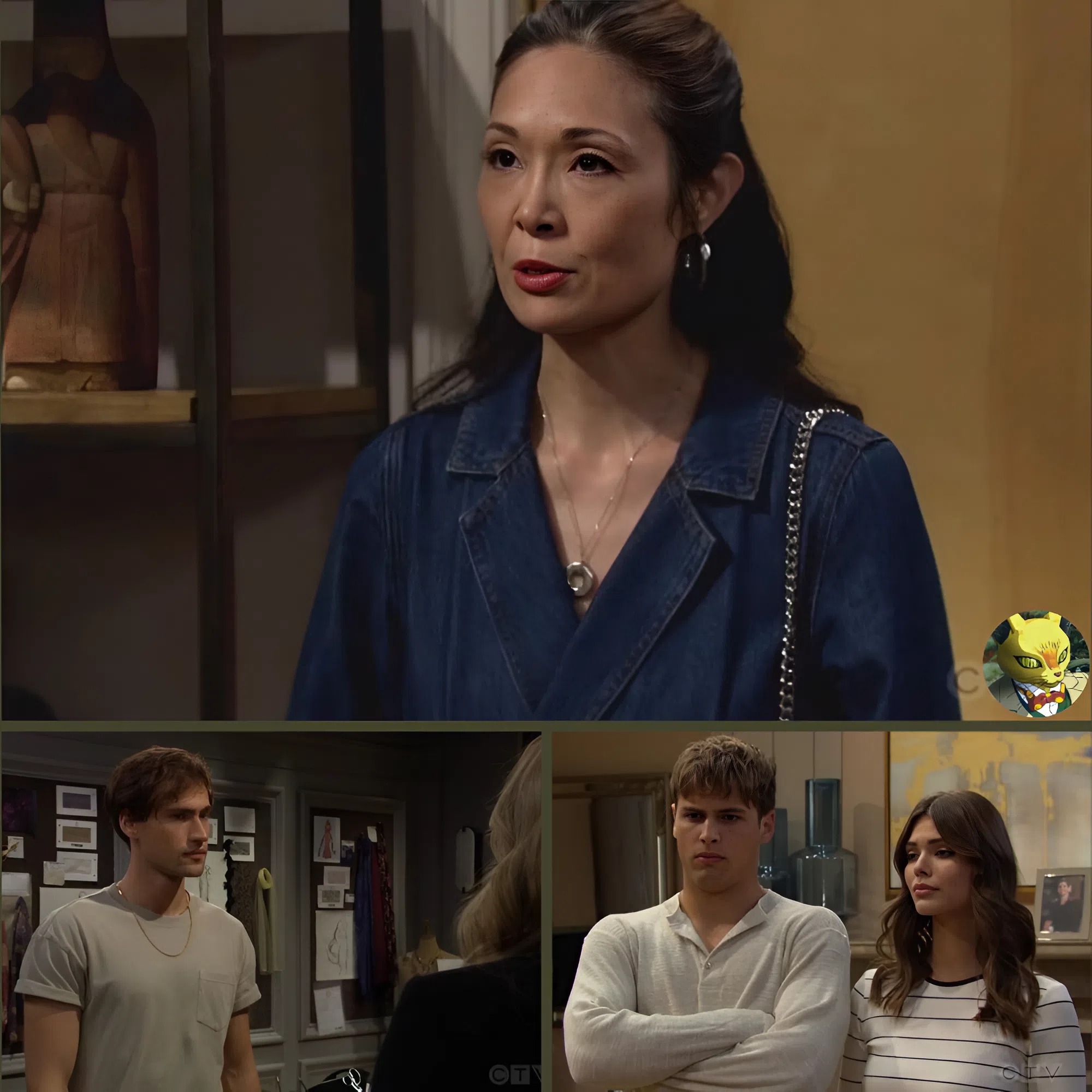



Emotions explode on The Bold and the Beautiful this week as family rivalries, heartbreak, and long-buried truths collide once again in Los Angeles. Monday’s episode, airing October 20, 2025, promises explosive confrontations, long-awaited reunions, and one mother’s shocking cruelty toward her own daughter.
Poppy’s Prison Showdown With Luna

After learning her daughter is alive — and pregnant with Will Spencer’s baby — Poppy Nozawa wastes no time confronting Luna in prison. But rather than showing compassion, Poppy arrives full of venom.
She taunts Luna, accusing her of using Will to “climb into Spencer money” and calling her a manipulative gold-digger. Luna, still fragile but determined, fires back that her feelings for Will were real.
“I loved him, Mom. You can’t twist that,” Luna insists.
But Poppy isn’t moved. She coldly warns Luna that Bill Spencer won’t be her savior this time — and that no one is coming to rescue her from the mess she created.
As Luna fights to defend her dignity, Poppy reminds her that her actions have destroyed her reputation and alienated her from both the Forresters and the Spencers.
Luna Stands Her Ground
Despite her mother’s vicious words, Luna refuses to crumble. She tells Poppy that she takes responsibility for her mistakes but won’t let anyone rewrite her story. Still, Poppy’s cruelty hits hard — reminding Luna how completely she’s been cut off from the life she once knew.

Their strained relationship reaches a breaking point as Poppy storms out, leaving Luna alone and defeated — a young woman facing the consequences of her past and the uncertainty of her unborn child’s future.
Steffy Forrester’s Surprise Homecoming
Across town, John “Finn” Finnegan finally gets a reason to smile. After months away, Steffy Forrester returns home with Kelly and Hayes, bringing warmth and hope back into Finn’s life.
The reunion is tender — a rare moment of peace after so much turmoil. But the happiness doesn’t last long. Finn knows he must tell Steffy the truth about Luna’s survival — and everything that’s followed.
Steffy Learns the Truth About Luna
Steffy’s joy turns to shock as Finn reveals that Luna not only survived but is now behind bars — and pregnant with Will Spencer’s baby. The revelation leaves Steffy speechless.
While she’s relieved that Luna is no longer a danger to her family, Steffy is shaken by how long she was kept in the dark. Finn’s confession reopens old wounds and reignites Steffy’s mistrust of those who concealed the truth.
“You knew — and you didn’t tell me?” she asks, stunned.

The emotional fallout between them could threaten their newly rekindled stability.
Will and Electra Struggle to Reconnect
Meanwhile, Will Spencer and Electra Forrester attempt to rebuild their relationship, but Luna’s shadow continues to haunt them. Will is wracked with guilt and anger over being manipulated, while Electra’s resentment grows — especially as she struggles with the fact that Luna’s unborn child ties Will to her forever.
Their love may not survive the emotional wreckage Luna left behind.
Bill Spencer’s Overconfidence Could Cost Him
Elsewhere, Bill Spencer is determined to take control of the situation. Convinced he can win custody of Luna’s baby, he assures Katie and Will that everything will go his way.
But Bill’s trademark arrogance could backfire. If Luna’s legal team manages to exploit a technical loophole, she could retain her parental rights — and throw the Spencer family into fresh turmoil.
A Storm Is Brewing in Los Angeles
As Poppy’s cruelty deepens Luna’s despair and Steffy grapples with Finn’s shocking confession, The Bold and the Beautiful is building toward another emotional eruption. Secrets, guilt, and love continue to collide — and by week’s end, every family in Los Angeles will feel the shockwaves.
Curating Automotive Immortality: The 10 Most Visually Arresting Cars of All Time (2025 Edition)
Having spent over a decade immersed in the pulsating heart of the automotive world, from tracking vintage supercar market trends to dissecting the intricate lines of bespoke automotive artistry, I’ve witnessed firsthand how vehicles transcend mere transportation to become profound statements of design, engineering, and cultural impact. In 2025, as the industry hurtles towards electrification and autonomous futures, the enduring appeal of truly iconic design only intensifies, shaping our understanding of automotive aesthetic evolution and influencing the very fabric of luxury classic car investment.
The concept of “beauty” is inherently subjective, a dance between personal preference and universal principles of proportion, balance, and innovation. Yet, some vehicles possess an undeniable magnetic quality, a visual poetry that commands attention and admiration across generations. They aren’t just cars; they are rolling sculptures, testaments to human ingenuity and passion.
Our quest to identify the 10 most visually arresting cars of all time is more than a casual ranking; it’s a deep dive into the vehicles that have defined timeless vehicle aesthetics, becoming benchmarks for design excellence and solidifying their place as high-value collector automobiles. This isn’t just about what looks good today; it’s about what continues to resonate, what inspires new designers, and what holds its value – both intrinsic and monetary – in a rapidly changing market.
For this 2025 edition, we’ve considered not only their original impact but also their lasting legacy, their current collector status, and how their design philosophy informs the dialogue around future classic car predictions. Prepare to embark on a curated journey through automotive history, where form meets function in spectacular fashion, and art takes the wheel.
Mazda RX-7 (FD Generation)
Date: 1992-2002
Original Engine: 1.3-liter twin-turbo rotary, 255-276 hp (JDM)
Why It Earns Its Place: A masterclass in organic flow and quintessential sports car purity, the FD RX-7 transcends its era to remain a benchmark of evocative design.
When the third-generation Mazda RX-7 first graced the scene in the early 90s, it immediately announced itself as something special. From my perspective, tracing the arc of sports car design over the last thirty years, the FD is a triumph of understated aggression and natural elegance. Its long hood, cab-rearward stance, and exquisitely sculpted fenders don’t just mimic nature’s curves; they embody a sense of aerodynamic fluidity that feels both organic and purposeful. This isn’t a design that shouts; it whispers tales of speed and agility, an embodiment of the perfect predator in motion.
In 2025, the FD RX-7 has matured into a bona fide collectible sports car, its values steadily appreciating, particularly for well-preserved, low-mileage examples. The innovative but temperamental twin-turbo rotary engine, while a talking point, has only added to its mystique and character. Its design, however, is the undeniable star. It’s a car that looks fast even when standing still, perfectly proportioned, and devoid of unnecessary embellishments. Its impact continues to be felt in modern sports car language, a reminder that true beauty lies in balance and an unyielding commitment to form following function with artistic flair. For those seeking investment-grade vehicles that blend driving pleasure with stunning looks, a pristine FD RX-7 is a compelling proposition.
Talbot-Lago T150-C-SS ‘Teardrop’
Date: 1937-1939
Original Engine: 4.0-liter inline-six, 140 hp
Why It Earns Its Place: An unparalleled achievement in Art Deco coachbuilding, a liquid metal sculpture that pushes the boundaries of automotive art.
To merely call the Talbot-Lago T150-C-SS “Teardrop” a car feels reductive; it is, in every sense, a rolling sculpture, a testament to an era when coachbuilders were artists wielding metal. Produced in extremely limited numbers, predominantly by the French firm Figoni et Falaschi, its nickname “Goutte d’Eau” (drop of water) perfectly captures its essence. The lines flow with an almost liquid grace, from the dramatically elongated fenders that seamlessly integrate with the bodywork to the tapering tail that seems to have been sculpted by the wind itself.
Having studied countless designs, I can confidently say that the Teardrop remains one of the most audacious and successful attempts to fuse automotive design principles with the organic forms found in nature. In 2025, its status as a masterpiece of premium automotive craftsmanship is undisputed. These vehicles command staggering prices at auction, often crossing the eight-figure mark, making them not just million-dollar classic cars but truly unparalleled automotive art investments. Each curve, each rivet, speaks to a bespoke era where individuality and artistic expression were paramount. The Teardrop isn’t just beautiful; it’s historically significant, representing a pinnacle of pre-war design that continues to inspire awe.
Lancia Stratos HF
Date: 1973-1978
Original Engine: 2.4-liter Ferrari Dino V6, 190 hp (road car)
Why It Earns Its Place: A defiant, wedge-shaped icon that proves extreme purpose can result in breathtaking, unapologetic beauty.
The Lancia Stratos is a car born from a singular, ferocious purpose: rally dominance. Yet, from this uncompromising focus emerged a design that is nothing short of revolutionary and utterly captivating. Its extreme wedge profile, impossibly low stance, and aggressive, almost brutalist, aesthetic challenged every convention of its time. Designed by Bertone, the Stratos looks like it landed from another planet, a vision of the future that paradoxically became one of the most successful rally cars of the past.
My decade in the industry has taught me that the most enduring designs often come from a clear, unyielding vision. The Stratos is a prime example. Its compact dimensions and tight cabin were concessions to performance, but the overall effect is one of potent, distilled beauty. In 2025, the Stratos is more than a rally legend; it’s an iconic car design heritage piece, highly sought after by collectors for its rarity, its thrilling V6 engine borrowed from Ferrari, and its unparalleled visual aggression. Values for the road-going Stradale versions have consistently climbed, positioning it as a top-tier high-performance classic car and an incredibly shrewd luxury classic car investment. Its defiant aesthetics continue to resonate, proving that beauty can be unconventional, sharp, and utterly unforgettable.
Aston Martin DB9
Date: 2003-2016
Original Engine: 5.9-liter V12, 450-510 hp
Why It Earns Its Place: A definitive statement of British elegance and muscular sophistication, blending traditional grandeur with modern allure.
Aston Martin occupies a unique space in the pantheon of automotive design, consistently delivering vehicles that exude a particular brand of refined power. While many models could grace this list, the DB9, introduced in the early 2000s, stands out for me as a perfect distillation of Aston Martin’s enduring design language. It’s a car that somehow manages to be simultaneously aggressive and graceful, powerful yet understated. Its long hood, short rear deck, and flowing lines speak of classic grand tourer proportions, but with a modern, athletic tension.
What makes the DB9 so compelling in 2025 is its timelessness. Its design hasn’t aged a day, a testament to its fundamental perfection. It’s a car that avoids fleeting trends, opting instead for an elegant, muscular simplicity. The V12 engine, a masterpiece of engineering, only adds to its allure, cementing its position as a quintessential luxury lifestyle vehicle. As the automotive landscape shifts towards smaller engines and electrification, the DB9’s status as a powerful, naturally aspirated grand tourer makes it increasingly appealing to collectors and enthusiasts seeking premium automotive craftsmanship. It continues to represent the pinnacle of accessible Aston Martin design, offering a blend of beauty and performance that remains highly desirable and a solid example of investment-grade vehicles within its segment.
Fiat 500 (Nuova 500)
Date: 1957-1975
Original Engine: 0.5-0.6-liter two-cylinder, 13-21 hp
Why It Earns Its Place: The ultimate expression of charming, democratic design; proof that utility and universal appeal can be profoundly beautiful.
Beauty isn’t always about sweeping dramatic lines or immense power; sometimes, it’s found in pure, unadulterated charm and clever packaging. The original Fiat Nuova 500, launched in 1957, is a prime example. It was designed to mobilize a nation, to be affordable and accessible, yet its form is utterly delightful. With its diminutive size, rounded silhouette, and friendly “face,” the 500 is an exercise in minimalist design that achieves maximum impact. It’s undeniably cute, but that cuteness is underpinned by brilliant, practical styling.
From an expert’s perspective, the Nuova 500’s brilliance lies in its ability to evoke universal affection. It’s an automotive icon that transcends class and performance. In 2025, the original 500 remains a beloved classic, a symbol of Italian ingenuity and post-war optimism. Its enduring appeal is evident in the continuation of the “500” moniker for Fiat’s modern lineup. Pristine examples are becoming increasingly sought after, not necessarily as million-dollar classic cars, but as charming, accessible pieces of automotive history and art. It’s a joy to behold, a reminder that design excellence can be found in the most unassuming packages, proving that an economical car can also be a dream garage staple for its sheer aesthetic pleasure.
BMW Z8
Date: 1999-2003
Original Engine: 4.9-liter V8, 400 hp
Why It Earns Its Place: A stunning modern interpretation that respectfully channels the spirit of a legendary predecessor, while undeniably improving upon it.
The BMW Z8 is a fascinating study in retro-futurism, a modern roadster designed to evoke the timeless elegance of the legendary 1950s BMW 507, yet carving its own indelible mark. From my vantage point in the automotive design landscape, this is where a homage successfully surpasses its inspiration. Henrik Fisker’s design for the Z8 is a masterclass in proportion and restrained power. It blends classic roadster elements—long hood, muscular rear haunches, prominent kidney grille—with sleek, contemporary lines and exquisite detailing.
The Z8 is powered by the glorious S62 V8 engine from the E39 M5, giving it the performance to match its stunning looks. In 2025, the Z8 is firmly entrenched as a modern classic, a highly desirable high-value collector automobile. Its limited production numbers, powerful engine, and particularly its incredible design have ensured its value has consistently climbed. It’s not just a car; it’s a statement of sophistication, a nod to heritage without being overtly nostalgic. This car exemplifies how thoughtful design can bridge eras, appealing to those who appreciate both iconic car design heritage and the raw power of a high-performance classic car. It’s a remarkable piece of automotive aesthetic evolution, a testament to BMW’s willingness to blend art with engineering at its highest level.
Peugeot 406 Coupe
Date: 1996-2004
Original Engine: Various, including 3.0-liter V6, 194-210 hp
Why It Earns Its Place: Accessible elegance personified; a remarkably sophisticated, Italian-designed coupe proving beauty isn’t exclusive to the supercar elite.
Amidst a list dominated by multi-million-dollar exotics and historical giants, the Peugeot 406 Coupe stands out as a beacon of achievable beauty. Penned by Pininfarina, the legendary Italian design house, this car possesses an understated grace that defies its relatively modest price point, even in 2025. Its lines are clean, flowing, and perfectly balanced, devoid of any unnecessary aggression or ornamentation. It’s a testament to the power of classic proportions and elegant surfacing.
Having observed market trends for decades, I can attest that the 406 Coupe’s design has aged with remarkable poise. It has that rare quality of timelessness, making it look far more expensive and exclusive than it ever was. The rumor that it was based on a rejected Ferrari design, while likely apocryphal, speaks volumes about the perceived quality of its aesthetics. In 2025, a well-maintained 406 Coupe represents incredible value for those seeking design excellence without the exorbitant price tag. It’s a stylish, comfortable, and often overlooked future classic car prediction, embodying the notion that automotive artistry can be democratic. For enthusiasts looking to curate a dream garage of beautiful vehicles without breaking the bank, this elegant French-Italian collaboration is an absolute must-consider.
Alfa Romeo 33 Stradale
Date: 1967-1969
Original Engine: 2.0-liter V8, 230 hp
Why It Earns Its Place: An ethereal, sculpted masterpiece and one of the world’s first true supercars, embodying raw racing spirit in breathtaking road-legal form.
The Alfa Romeo 33 Stradale is, for many, the very definition of automotive perfection. Born directly from the Tipo 33 race car, it’s a rare, almost mythical creation. With only 18 examples ever built, its scarcity alone makes it extraordinary, but it’s the design that truly elevates it to legendary status. Franco Scaglione’s work here is nothing short of visionary: an impossibly low stance, butterfly doors that sweep upwards, curvaceous fenders, and a canopy-like greenhouse that gives it an almost alien, yet undeniably seductive, presence.
From my long career, I’ve learned that some designs simply transcend the pragmatic. The 33 Stradale, despite being notoriously impractical as a road car, is a pure expression of form. In 2025, it holds an almost sacred status among collectors and design aficionados. These are unequivocally million-dollar classic cars, often trading for tens of millions, solidifying their position as apex luxury classic car investment vehicles. It’s an original supercar, a benchmark for performance and beauty, and a cornerstone of automotive aesthetic evolution. Every line, every vent, every proportion is deliberate, resulting in a shape that continues to captivate and inspire, a true testament to automotive art investment.
Citroën DS
Date: 1955-1975
Original Engine: Various, including 1.9-liter I4, 75 hp
Why It Earns Its Place: A radical, aerodynamically advanced, and aesthetically revolutionary family car that redefined the automotive landscape.
When the Citroën DS debuted at the Paris Motor Show in 1955, it was nothing short of a revelation. Its futuristic, aerodynamic “Goddess” (Déesse) form captivated crowds, but its beauty was more than skin deep. Beneath the sleek exterior lay a suite of groundbreaking innovations: hydropneumatic suspension for an unparalleled ride, power steering, and disc brakes. The DS wasn’t just beautiful; it was brilliantly engineered, proving that radical design could coexist with practical family transport.
My experience has shown me that truly impactful designs often blend aesthetic daring with functional innovation. The DS is a prime example. Its seamless lines, covered rear wheels, and distinctive roofline created a silhouette unlike anything else on the road, setting new standards for automotive styling. In 2025, the DS remains an icon, admired for its audacious design and engineering prowess. It’s a beloved classic, particularly in Europe, and continues to be an interesting investment-grade vehicle for those seeking unique vintage car market trends. Its influence is palpable, not just in Citroën’s subsequent designs but in the broader conversation about how cars can be both highly functional and profoundly artistic. The DS is a reminder that design excellence can be achieved by truly thinking outside the box.
Chevrolet Corvette (C2 ‘Sting Ray’)
Date: 1963-1967
Original Engine: Various, including 5.4-liter (small block) to 7.0-liter (big block) V8, up to 435 hp
Why It Earns Its Place: The quintessential American sports car, a powerful statement of bold, curvaceous design and raw performance that defines an era.
The second-generation Chevrolet Corvette, universally known as the “Sting Ray,” is a design masterpiece that perfectly encapsulates American automotive swagger. Launched in 1963, its iconic split-window rear (for 1963 only) and dramatic “coke-bottle” waistline were revolutionary. Bill Mitchell’s design team crafted a car that was simultaneously elegant and ferociously powerful, its forms inspired by nature and its name by a creature of the sea. It was a clear departure from the C1, propelling the Corvette into the realm of truly world-class sports car design.
From my perspective, the C2 Sting Ray’s enduring appeal lies in its audacious curves and perfect proportions. It’s a car that screams excitement, a tangible representation of the muscle car era’s zenith. In 2025, the C2 Sting Ray is not just a highly sought-after collectible sports car but a cornerstone of any serious curated car collection. Values for pristine, numbers-matching examples, especially those with the legendary big-block engines, continue to soar, cementing its status as a significant luxury classic car investment. Its blend of striking aesthetics and potent V8 performance makes it a defining example of high-performance classic cars and a permanent fixture in the pantheon of dream garage vehicles. It is, unequivocally, American automotive design at its most potent and visually compelling.
Your Next Drive Awaits: Explore the Legacy of Automotive Artistry
These ten vehicles, spanning nearly a century of innovation and artistic endeavor, represent more than just beautiful machines. They are milestones in automotive design excellence, embodying the passion, ingenuity, and cultural shifts of their respective eras. Their enduring appeal, their rising status as high-value collector automobiles, and their influence on contemporary design are testaments to their truly immortal aesthetic.
Whether you’re an avid collector seeking your next investment-grade vehicle, an enthusiast dreaming of million-dollar classic cars, or simply someone who appreciates the profound intersection of art and engineering, these icons offer endless inspiration. We invite you to delve deeper into their stories, perhaps even experience one firsthand, and share your own perspectives on the timeless vehicle aesthetics that continue to captivate you.
What design, in your opinion, defines automotive beauty? Join the conversation and let the exploration of automotive art investment continue.