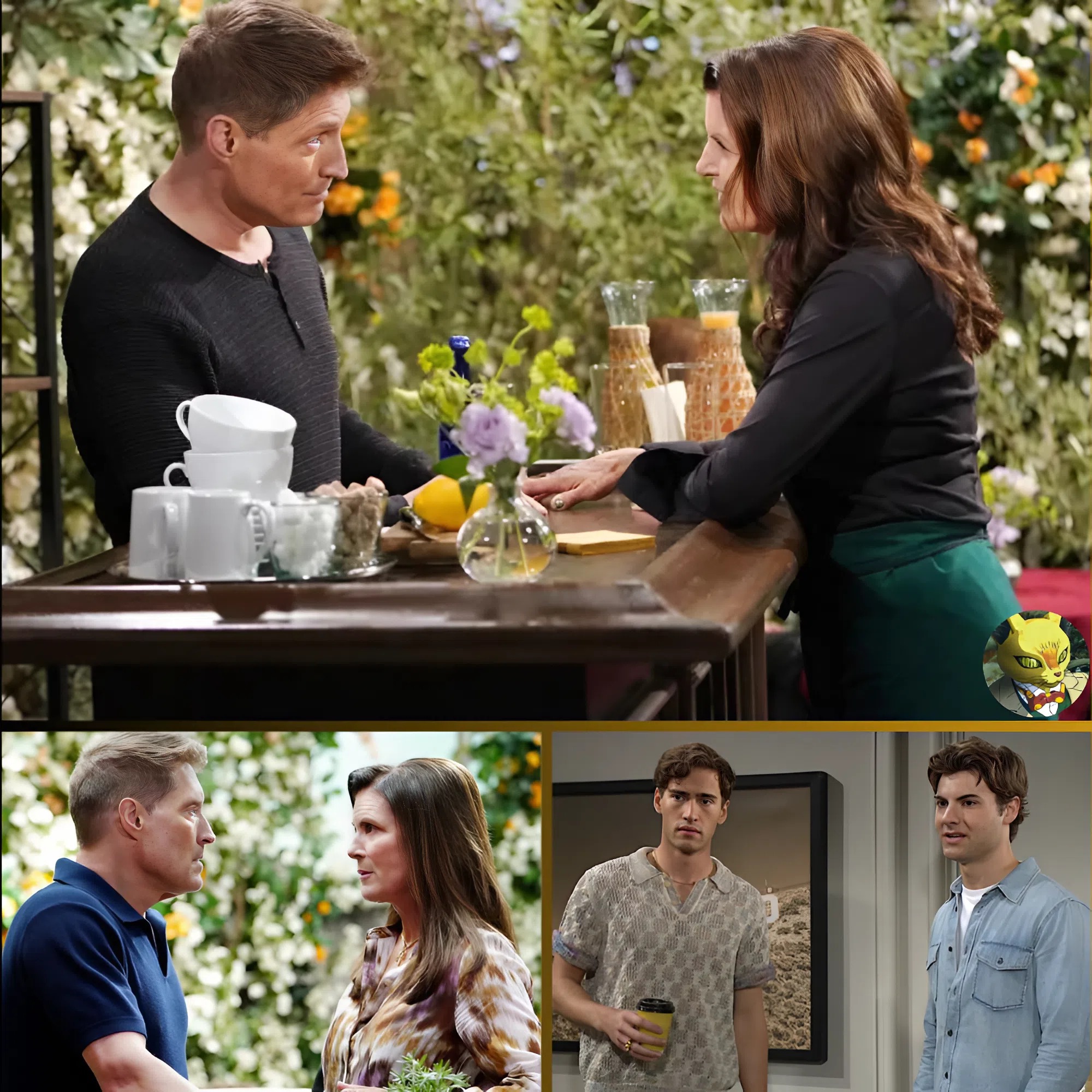



In Tuesday’s (October 21) emotionally charged episode of The Bold and the Beautiful, Luna Nozawa (Lisa Yamada) proved that she can still stir up chaos from behind bars. Pregnant, delusional, and convinced that she can manipulate her way out of prison, Luna made a few sharp observations — but just as many catastrophic miscalculations.
Here’s why Luna is partly right about her situation… and why she’s still dangerously wrong.
Luna’s Right: Bill’s Still Emotionally Invested
Luna may be manipulative, but she’s not blind to Bill Spencer’s (Don Diamont) weak spot — his family. Despite his fury over her actions, Bill can’t ignore that she’s carrying his grandchild. That emotional tether makes Luna believe she still has leverage.
And in a way, she’s not wrong. Bill and Katie (Heather Tom) are already mobilizing to seek custody of the unborn child, ensuring it grows up far away from Luna’s influence. Even if his feelings for Luna are nonexistent, Bill’s protective instincts toward the baby give her a sliver of relevance.

Luna also knows that the Spencer name carries power, and she’s betting that her pregnancy keeps her connected to it — at least for now. “He won’t let his grandchild grow up in prison,” Luna mutters, clinging to the last ounce of control she thinks she has.
Luna’s Wrong: She’s Living in a Fantasy
But Luna’s biggest mistake is believing that her pregnancy gives her a future with Will Spencer (Crew Morrow). Will’s heart belongs to Electra (Laneya Grace), and he’s made it crystal clear that he wants nothing to do with Luna — or her manipulative games.
Steffy Forrester (Jacqueline MacInnes Wood) tried to drill that reality into her during their tense prison confrontation. Steffy reminded Luna that she’s not part of the Spencer family, just the mother of a child they’ll raise without her. Luna may have once fooled Bill into mercy, but that mercy is gone.
“You’re not a Spencer,” Steffy tells her. “The baby is. You’re just the problem they’re cleaning up.”
Still, Luna’s delusion runs deep. By the end of the episode, she hatches another disturbing plan — asking her cellmate to punch her in the stomach to fake an attack. She hopes that Bill will panic, believe she’s in danger, and use his influence to get her released from prison.

It’s a chilling move that shows just how far Luna is willing to go — and how detached from reality she’s become.
The Bottom Line
Luna’s instincts about Bill’s lingering guilt and emotional vulnerability might be spot-on. But her refusal to face the truth — that the Spencers will fight for the baby, not for her — will likely be her undoing.

Her manipulative tactics once bought her time. Now, they’re digging her deeper into a hole that even Bill’s power might not be able to pull her from.
What’s Next for Luna?
Rumors suggest that Luna’s latest stunt could backfire in the worst way. If Bill discovers she faked another attack, she could be moved to solitary confinement, cutting off her last chance at contact with Will.
Meanwhile, behind the scenes, actress Lisa Yamada’s Daytime Emmy win has fans speculating that Luna’s storyline is about to take another shocking twist — possibly one that forces her to finally confront her past and the mess she’s created.
The Unrivaled 10: Iconic Automotive Masterpieces That Define Timeless Beauty (2025 Edition)
As an automotive aficionado with a decade immersed in the pulsating heart of car design, engineering, and collector markets, few topics ignite passion quite like the enduring allure of genuinely beautiful automobiles. While the relentless march of technology propels us toward an electrified, autonomous future, the magnetic appeal of design perfection from yesteryear remains undimmed. For many, a car is merely a conveyance, a pragmatic tool for daily life. Yet, for countless others—myself included—it transcends utility, becoming a profound statement where art, engineering, and human aspiration converge.
The pursuit of aesthetic excellence in car manufacturing has, over the past century, yielded a pantheon of machines that are more than just metal, glass, and rubber; they are rolling sculptures, pieces of functional art that command attention and admiration. Curating a definitive list of the “most beautiful cars” is, by its very nature, a deeply subjective endeavor, fraught with passionate debate and inevitable omissions. The sheer volume of stunning designs from storied marques worldwide means that narrowing it down to just ten road-legal icons for this 2025 perspective is a Herculean task. Our goal isn’t just to list pretty cars, but to identify automotive design icons whose aesthetic impact has transcended generations, whose lines still captivate, and whose influence continues to resonate even amidst the radical shifts defining the 2025 automotive landscape.
This isn’t just a nostalgic look back; it’s an exploration of enduring design principles, market valuation in the current climate, and the lasting legacy of these investment-grade automobiles. Prepare to delve into the captivating narratives of ten such masterpieces that continue to define timeless car design, inspiring collectors, designers, and dreamers alike.
Mazda RX-7 (FD)
Why It Endures: A symphony of organic curves and aggressive stance, the FD RX-7 epitomizes the late 20th-century Japanese sports car aesthetic. Its design, almost two generations removed from current production, continues to command respect and admiration, making it a prime target for collectible sports car enthusiasts.
Launched in 1992, the third-generation Mazda RX-7, often badged as the ɛ̃fini RX-7 in its domestic market, represented a zenith of automotive styling. Gone were the sharp angles and pop-up headlights that defined many of its contemporaries. Instead, the FD presented a remarkably fluid, almost liquid form, as if sculpted by wind and water rather than pressed steel. Its wide, low-slung body, long hood, and short tail gave it perfect sports car proportions, while subtle bulges over the wheels added a muscular tension without resorting to overt aggression. This was a car that didn’t just move through the air; it seemed to slice it with elegant precision.
Beneath that breathtaking skin lay an equally innovative 1.3-liter twin-turbo rotary engine. While rotary powerplants have always been polarizing due to their unique maintenance demands, the FD’s powertrain perfectly complemented its lightweight (around 2,800 lbs) and balanced chassis. Driving an FD RX-7, especially a well-maintained manual example, is a visceral experience that matches its visual promise.
2025 Perspective: In the 2025 market, the FD RX-7’s status as a JDM legend is stronger than ever. Investment in classic Japanese sports cars is booming, and clean, original examples—especially those with lower mileage and documented histories—are seeing significant appreciation. Values for pristine manual FDs have steadily climbed well into the six figures for exceptional models, solidifying its position as a highly sought-after automotive heritage investment. The rarity of genuinely unmolested examples, coupled with a passionate global fanbase, ensures its place as a cornerstone in any serious collection of exotic car appreciation.
Talbot-Lago T150-C-SS ‘Teardrop’ Coupé by Figoni et Falaschi
Why It Endures: A pre-war masterpiece that transcends mere transportation, the ‘Teardrop’ is the embodiment of Art Deco elegance, a truly unparalleled piece of premium automotive art.
Emerging from the golden age of coachbuilding in the late 1930s, the Talbot-Lago T150-C-SS chassis was a canvas for some of the world’s most imaginative designers. Among them, Figoni et Falaschi achieved automotive immortality with their “Goutte d’Eau” or ‘Teardrop’ coupé. This car isn’t merely designed; it’s sculpted. Its lines flow seamlessly from nose to tail, evoking the perfect aerodynamic form of a water droplet. The covered wheels, integrated fenders, and low roofline create an unbroken, organic silhouette that is both sensual and futuristic, even by 2025 standards.
Powered by a 4.0-liter six-cylinder engine, the ‘Teardrop’ was a luxury grand tourer, designed for opulence and speed. But its true genius lies in its visual impact. It challenges the very notion of what a car can be, pushing the boundaries of aesthetics into pure art.
2025 Perspective: Almost a century after its creation, the ‘Teardrop’ remains an absolute pinnacle of automotive heritage investment. With only a handful ever built (estimates vary, but around 16 true Teardrop coupes exist, with variations), its rarity and stunning design have driven its value into the ultra-luxury stratum. In the 2025 market, these are not just cars; they are masterpieces on wheels, consistently fetching multi-million-dollar sums at high-end vehicle acquisition auctions, often breaking records for French automobiles. They are a testament to bespoke craftsmanship and visionary design, securing their place among the most valuable and investment-grade automobiles on the planet.
Lancia Stratos HF
Why It Endures: A wedge-shaped marvel of aggressive functionality, the Stratos is a compact, purpose-built machine where minimalist design meets uncompromising performance, a testament to pure sports car design.
Born in the early 1970s, the Lancia Stratos was conceived with a singular, audacious purpose: to dominate the World Rally Championship. Its design, penned by Marcello Gandini at Bertone, was revolutionary. Short, wide, and incredibly low, the Stratos was a radical departure from conventional sports car aesthetics. The steeply raked windshield, minimal overhangs, and unmistakable wedge profile made it instantly recognizable and profoundly impactful. Every line, every angle, served a functional purpose, yet combined to create a form of breathtaking beauty.
Power came from a mid-mounted Ferrari Dino 2.4-liter V6, providing exceptional performance to match its nimble chassis. While its road-going versions (built to homologate the rally car) were notoriously cramped and offered limited visibility, these concessions were willingly made for the sake of its unparalleled rallying prowess and iconic looks.
2025 Perspective: The Lancia Stratos continues to be a darling among collectors of classic rally cars and discerning enthusiasts who appreciate its brutalist beauty and legendary motorsports pedigree. In 2025, its unique design language, combined with its World Rally Championship victories, ensures its status as a highly desirable exotic car appreciation piece. Values have been steadily climbing for years, with excellent examples regularly commanding sums upwards of £500,000 (or equivalent in USD) at auction, solidifying its place as an investment-grade automobile with proven historical significance and aesthetic appeal.
Aston Martin DB9
Why It Endures: A masterclass in restrained elegance and athletic grace, the DB9 embodies Aston Martin’s enduring design philosophy: sophisticated power without overt ostentation, a true benchmark for luxury sports car aesthetics.
Aston Martin’s design language, particularly through the early 2000s, forged a consistent aesthetic identity, making it challenging to pick just one model. However, the DB9, launched in 2003, stands out as a particular triumph of proportion and visual balance. Its long, flowing bonnet, sculpted flanks, and gently sloping roofline create an athletic yet refined silhouette. There’s an inherent rightness to its curves, a muscularity that feels organic rather than forced. It’s a car that commands respect through its understated confidence, embodying the very essence of British sophistication.
Powered by a glorious 5.9-liter V12, the DB9 delivered both exhilarating performance and grand touring comfort. Its design captured the perfect blend of traditional Aston Martin cues and a modern interpretation of the brand’s identity, setting the stage for subsequent models while remaining an icon in its own right.
2025 Perspective: In 2025, the Aston Martin DB9 continues to represent exceptional value in the luxury classic car market. While newer Aston models push the boundaries of technology and performance, the DB9’s timeless aesthetic ensures its enduring appeal. Its relative affordability compared to its initial high-end vehicle acquisition cost makes it an attractive proposition for collectors seeking a refined, visually stunning grand tourer. Clean, well-maintained examples are appreciating steadily, recognized for their V12 engines and Pforzheim-penned lines, offering a strong argument for automotive heritage investment in the modern era.
Fiat 500 (Nuova 500)
Why It Endures: Proof that profound beauty can exist in miniature, the original Fiat 500 is an utterly charming and universally beloved icon of accessible, intelligent design. It’s the definitive city car aesthetic.
When the Fiat Nuova 500 arrived in 1957, Italy was rebuilding, and the demand was for affordable, efficient, and practical transportation. What Fiat delivered, however, was also undeniably beautiful. Its diminutive size, rounded forms, and cheerful demeanor made it instantly endearing. The 500 wasn’t just cute; it was a masterclass in packaging and proportion, offering maximum utility from minimal dimensions. Every element, from its simple headlights to its canvas roll-back roof, contributed to its cohesive and utterly delightful appearance.
Powered by a tiny 0.48-liter to 0.6-liter air-cooled engine, the 500 was never about speed, but about liberation and mobility for the masses. It symbolized a post-war optimism and became a cultural touchstone, beloved for its character and undeniable visual appeal.
2025 Perspective: In the 2025 market, the original Fiat 500 holds a unique place. It’s not a multi-million-dollar supercar, but its cultural significance and enduring charm make it a highly desirable vintage car for collectors seeking a piece of automotive history with universal appeal. Pristine examples, particularly the rarer “Sport” versions or those meticulously restored, are seeing steady appreciation, especially in urban centers where its charm translates into strong demand for classic car aesthetics. It represents an accessible entry point into automotive heritage investment, proving that beauty and collectible status aren’t exclusive to the ultra-wealthy. Its influence is still felt in the modern Fiat 500, making it a bridge between past and present design philosophies.
BMW Z8
Why It Endures: A masterful blend of retro inspiration and modern execution, the BMW Z8 is a sculptural roadster that arguably surpasses the classic it honored, standing as a triumph of neo-classic automotive design.
The BMW Z8, launched in 1998, was a deliberate homage to the iconic 1950s BMW 507. Yet, rather than a mere reproduction, it was a reinterpretation that managed to capture the spirit of its ancestor while forging its own distinct, and arguably superior, aesthetic identity. Penned by Henrik Fisker and largely based on the E52 concept car by Chris Bangle, the Z8 is a marvel of proportion. Its long hood, short tail, wide stance, and subtle curvature create a sophisticated yet powerfully athletic silhouette. The minimalist interior, with its centrally mounted gauges, reinforced the timeless, uncluttered design philosophy.
Underneath its exquisite skin, the Z8 was a true performance machine, powered by the formidable 4.9-liter V8 engine from the E39 M5. This blend of potent performance and breathtaking design, available only in left-hand drive, made it an instant classic and a formidable luxury sports car.
2025 Perspective: In 2025, the BMW Z8 has firmly cemented its status as a highly coveted investment-grade automobile. Its limited production numbers (around 5,700 globally), powerful V8 engine, and exquisite design make it a darling of high-end vehicle acquisition and collection. Values have soared in recent years, placing it firmly in the category of exotic car appreciation. Its blend of modern performance and timeless aesthetics, especially its connection to a classic icon, makes it a unique and valuable asset in the collector market, often seen gracing Concours d’Elegance winners circles.
Peugeot 406 Coupe
Why It Endures: An understated masterpiece of collaborative design, the Peugeot 406 Coupe showcases how elegant simplicity and perfect proportions can create accessible beauty, a quiet giant in timeless European design.
The Peugeot 406 Coupe, introduced in 1996, is perhaps the most surprising entry on this list, not because it lacks beauty, but because of its relative affordability in a lineup of high-priced premium automotive art. This stunning four-seater coupe was styled by Pininfarina, the legendary Italian design house responsible for some of Ferrari’s most iconic creations. Rumors once suggested it was an adaptation of a rejected Ferrari design, a testament to its inherent beauty. The reality, however, is that it was simply a magnificent expression of Pininfarina’s skill applied to a more accessible platform.
Its lines are clean, flowing, and remarkably elegant. There are no unnecessary flourishes; every curve and surface seems to be in perfect harmony. It embodies a subtle sophistication, a relaxed confidence that often eludes more overtly aggressive designs. The long hood, graceful roofline, and neatly integrated rear create an effortlessly stylish package.
2025 Perspective: For 2025, the Peugeot 406 Coupe remains an incredible opportunity for accessible classic car aesthetics. While not commanding the multi-million-dollar figures of other vehicles on this list, pristine V6 manual examples are steadily appreciating, recognized by discerning enthusiasts for their exceptional design pedigree and driving dynamics. It represents a fantastic automotive heritage investment for those looking for European elegance without the stratospheric price tag. Its Pininfarina provenance ensures its design value will continue to be recognized, making it a “future classic car 2025” contender for smart collectors.
Alfa Romeo 33 Stradale
Why It Endures: A sublime fusion of racing pedigree and road-car artistry, the 33 Stradale is an ethereal sculpture of unparalleled beauty, pushing the boundaries of what a vintage supercar could be.
The Alfa Romeo 33 Stradale, unveiled in 1967, is not merely a beautiful car; it is a profound artistic statement. Derived from Alfa Romeo’s Tipo 33 race car, the Stradale (Italian for “road”) was a rare and exotic beast, with only around 18 examples ever built. Designed by Franco Scaglione, its form is breathtakingly sensuous. The low-slung, curvaceous body, dramatic butterfly doors, and impossibly wide rear fenders create an organic, almost liquid sculpture. It’s a car that appears to be in motion even when standing still, a testament to its inherent dynamism.
Power came from a magnificent 2.0-liter V8, a racing engine detuned only slightly for road use, producing a mesmerizing soundtrack. Its astronomical price at launch (the most expensive car in the world at the time) and impractical nature were irrelevant; this was pure automotive art for the connoisseur.
2025 Perspective: In 2025, the Alfa Romeo 33 Stradale stands as one of the most desirable and valuable exotic car appreciation assets globally. Its extreme rarity, racing lineage, and utterly timeless design place it firmly in the “many, many millions” valuation bracket, often seen among Concours d’Elegance winners. It’s a crown jewel for any serious automotive heritage investment portfolio, embodying a perfect, if fleeting, moment in supercar design. The recent unveiling of a new, modern 33 Stradale for 2025 only further underscores the enduring legacy and iconic status of the original masterpiece.
Citroën DS
Why It Endures: A revolutionary blend of engineering prowess and avant-garde design, the Citroën DS redefined automotive aesthetics and technology, standing as a pillar of innovative French design.
When the Citroën DS debuted at the Paris Motor Show in 1955, it caused an immediate sensation. Its aerodynamic, futuristic body, penned by Flaminio Bertoni, looked like nothing else on the road. The DS seemed to glide into the future, with its sleek profile, covered rear wheels, and distinctive front end. It wasn’t just beautiful; it was intelligent design, where form followed groundbreaking function. The iconic single-spoke steering wheel and luxurious interior further cemented its reputation as a vehicle decades ahead of its time.
Beyond its visual appeal, the DS was an engineering marvel, featuring innovations like self-leveling hydropneumatic suspension (delivering an impossibly smooth ride), disc brakes, and power steering. It was practical family transport as much as it was an artistic statement, proving that groundbreaking aesthetics could coexist with real-world utility.
2025 Perspective: In the 2025 market, the Citroën DS maintains its status as an undisputed automotive design icon. Its historical significance, combined with its enduring aesthetic appeal, makes it a highly desirable vintage car for collectors. While not reaching the hyper-car values, well-preserved examples, especially the rarer “Pallas” luxury models, are seeing strong appreciation as automotive heritage investments. It continues to inspire designers, and its innovative approach to comfort and aerodynamics holds relevance even in discussions about electric vehicle aesthetics and future mobility, proving that true genius transcends eras.
Chevrolet Corvette (C2 ‘Sting Ray’)
Why It Endures: The quintessential American sports car, the C2 Corvette ‘Sting Ray’ is a powerful declaration of muscular elegance, a design masterpiece that perfectly encapsulates mid-century American optimism and performance. It is the definitive American sports car aesthetic.
Launched in 1963, the second-generation Chevrolet Corvette, famously known as the ‘Sting Ray,’ was a radical departure from its predecessor and an instant classic. Its design, heavily influenced by Bill Mitchell and Larry Shinoda, was a powerful fusion of aggressive performance and sophisticated styling. The iconic ‘coke-bottle’ waistline, razor-sharp fender creases, hidden headlights, and the distinctive split rear window (for 1963 only) created a visually stunning and dynamic profile. The ‘Sting Ray’ wasn’t just fast; it looked fast.
Available with a range of powerful V8 engines, from the ‘small block’ to the legendary ‘big block’ 427, the C2 delivered blistering performance to match its captivating looks. Its fiberglass body not only contributed to its light weight but also allowed for these incredibly complex and beautiful shapes.
2025 Perspective: In 2025, the C2 Corvette ‘Sting Ray’ remains an absolute cornerstone of the classic American muscle car market and a highly sought-after investment-grade automobile. Pristine examples, especially those with desirable engine and transmission combinations (like the fuel-injected 327 or the L78/L88 427s), are consistently among the strongest performers in exotic car appreciation. Its iconic status, raw power, and stunning design make it a perennial favorite at auctions and a testament to American automotive prowess. Collectors globally seek out these Concours d’Elegance winners, solidifying the C2’s enduring legacy as a symbol of automotive passion and design excellence.
Your Turn to Define Beauty
The cars on this list, while diverse in origin, purpose, and price point, share a common thread: an unparalleled commitment to aesthetic perfection. They are more than machines; they are statements, aspirations, and enduring pieces of human creativity. As we navigate the rapidly evolving landscape of 2025 automotive technology, these automotive design icons remind us that true beauty, whether in form, function, or the emotion it evokes, is truly timeless.
Which of these legends stirs your soul the most? Do you have an unsung hero of classic car aesthetics that you believe deserves a place among these titans? We invite you to delve deeper into the world of premium vehicle appreciation and share your own definitive picks. Join the conversation and explore what truly defines a most beautiful car for you.