


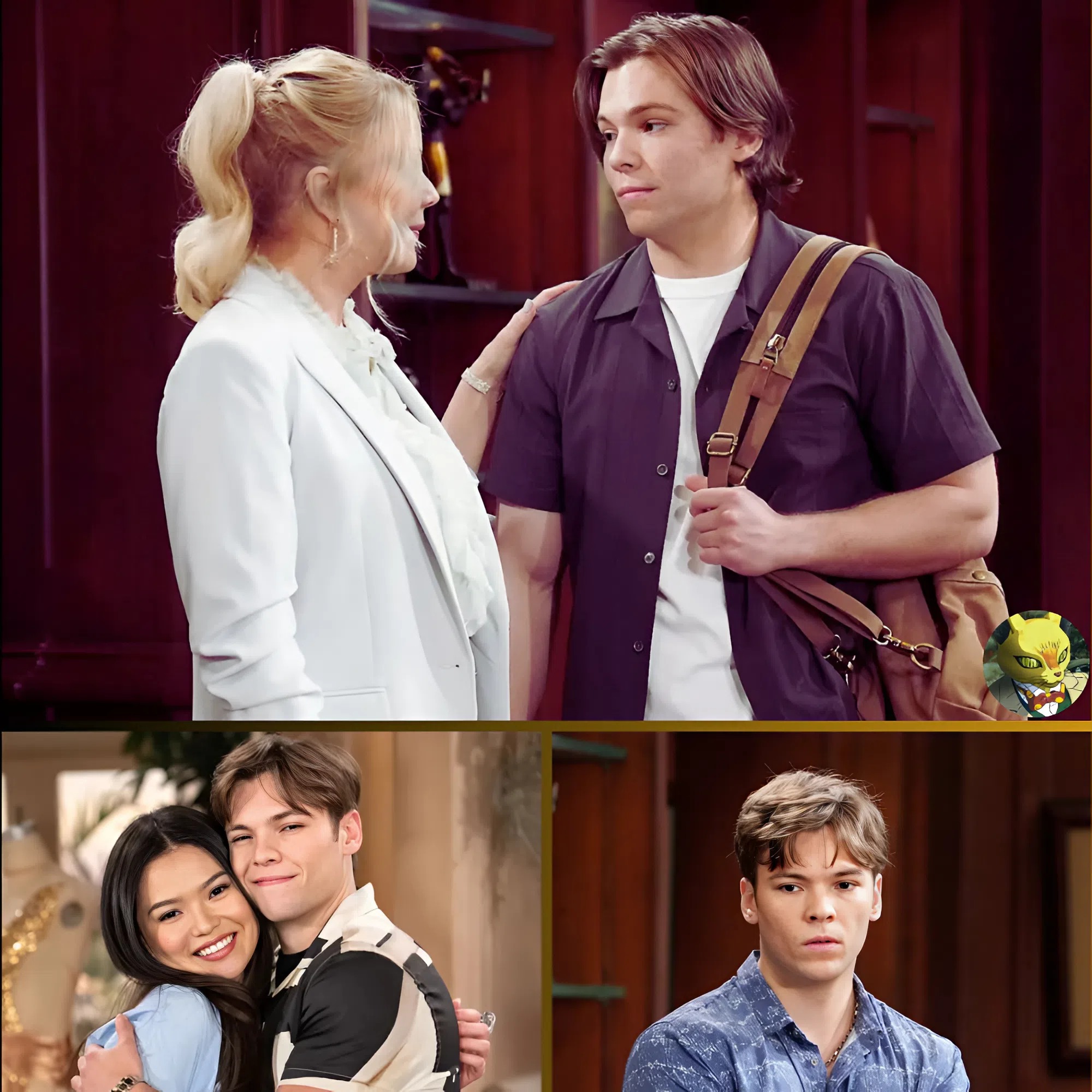
It’s been a full year since RJ Forrester last appeared on The Bold and the Beautiful, and fans are officially losing patience. As the son of supercouple Brooke Logan and Ridge Forrester, RJ is a core legacy character whose absence has left a noticeable gap in the Forrester family dynamic — and viewers are making it clear they want him back.
RJ’s Legacy and Rise at Forrester Creations
Born in 2004, Ridge Jr., or RJ, grew up in the shadow of fashion royalty. After spending much of his youth at boarding school, he made several short-term returns to Los Angeles over the years, each time bringing new energy and potential to the show.
When Joshua Hoffman stepped into the role in 2023, RJ’s storyline finally gained traction. Fans saw him trade in his influencer lifestyle for a future in fashion design, joining Forrester Creations to help his grandfather Eric Forrester (John McCook) with what became his final collection.
Eric’s pride in RJ was unmistakable, even crowning him “The Anointed One” — a symbolic passing of the torch from one Forrester generation to the next.

But as B&B storylines shifted toward Luna’s reign of chaos, RJ’s screen time dwindled. His final appearance came in October 2024, leaving viewers wondering why such a vital character disappeared so suddenly.
Fans Demand RJ’s Return
The calls for RJ’s comeback reignited recently when The Bold and the Beautiful’s official Instagram page posted birthday wishes for actor Joshua Hoffman. Fans flooded the comments section, demanding to know where RJ had gone.
“Bring him back! He’s awesome!” one fan exclaimed.
“Is he ever coming back to the show? We need some RJ content,” another wrote.
“Where the hell is RJ? He was Luna’s first victim, and no one cares. He should’ve been front and center during all the chaos,” a third added.
Many feel that RJ’s storyline was unfairly cut short, especially considering his emotional connection to Luna’s downfall and the family drama surrounding Forrester Creations.
Potential Storylines for RJ’s Return
If RJ does make his long-awaited return to Los Angeles, there’s no shortage of drama waiting for him.
1. Confronting Luna:
RJ was one of Luna’s earliest victims before her violent spiral. Seeing him face her again — now that she’s alive and pregnant — would give fans long-awaited closure.
2. A Love Triangle with Electra and Will:
Electra (Laneya Grace) is currently dating RJ’s cousin Will Spencer (Crew Morrow), but with tension rising in their relationship, she could easily find comfort in RJ. That twist would set up a fiery cousin rivalry — and reignite the legendary Logan family feud between Brooke and Katie.

3. A Design Duel with Deke:
Back at Forrester, RJ could return to reclaim his creative edge — but this time, he’d face off against Deke (Harrison Cone), the up-and-coming designer who’s quickly making waves. The stakes would be personal, too, since both men have ties to Hope Logan (Annika Noelle) and her fashion line.
Why RJ’s Return Matters
RJ represents the next generation of the Forresters — a bridge between the show’s rich history and its modern direction. His charm, creative passion, and deep family ties make him an essential part of The Bold and the Beautiful’s future.
Fans aren’t just calling for nostalgia; they’re calling for balance — a return to the family dynamics that made the show iconic.
The Pinnacle of Automotive Art: 10 Enduring Designs That Still Define Beauty in 2025
In my decade navigating the intricate world of automotive design and the evolving collector market, I’ve witnessed countless trends come and go. Yet, certain vehicles possess an intrinsic, timeless appeal that transcends mere functionality or fleeting fads. They are more than just machines for transportation; they are moving sculptures, masterpieces where engineering perfectly fuses with artistic vision. For enthusiasts and investors alike, identifying these exemplars of beauty is paramount, not just for aesthetic appreciation but often for astute financial ventures in the burgeoning classic car sector.
The year 2025 sees the classic car market continue its robust trajectory, with discerning collectors increasingly valuing originality, design pedigree, and historical significance. As an expert who has analyzed market shifts, restoration costs, and investment-grade automobiles, I can confidently say that true automotive beauty remains a top driver for value. While the concept of “beauty” is inherently subjective, there are designs that have consistently captivated generations, provoking emotional responses that resonate deeply with anyone who appreciates form and function in harmony.
Our editorial team, a collective of seasoned automotive connoisseurs, has engaged in passionate debate to distill a list of ten cars that, even in the electrified, autonomous era of 2025, stand as the epitome of automotive aesthetics. This selection deliberately focuses on road-legal models, each representing a unique facet of design brilliance. From groundbreaking aerodynamic forms to subtle curves that evoke pure emotion, these vehicles not only represent historical high points but also offer profound insights into the future of automotive art. Whether you’re a seasoned collector seeking your next high-value classic car investment or simply an admirer of exquisite craftsmanship, prepare to have your aesthetic senses ignited. Here are the ten vehicles that, in my expert opinion, unequivocally stand as the most beautiful ever conceived.
Mazda RX-7 (FD Generation)
Launch Year: 1992 (though its influence endures in 2025)
Why It Endures: The FD generation Mazda RX-7 isn’t just a sports car; it’s a profound statement in aerodynamic fluidity and organic design, a design philosophy that continues to inspire modern vehicle aesthetics. Introduced in the early 90s, the RX-7 FD emerged as a beacon of Japanese automotive excellence, embodying a sleek, almost liquid form that seemed sculpted by the wind itself rather than stamped from steel. Its low-slung profile, expansive greenhouse, and exquisitely proportioned curves coalesce into a design that, even thirty years later, appears utterly contemporary and effortlessly athletic.
From an expert perspective, what elevates the FD RX-7 beyond a mere performance machine is its singular focus on purity of form. There are no extraneous lines, no gratuitous vents; every element serves a purpose, either functionally or aesthetically. The pop-up headlights, a hallmark of its era, retract seamlessly into the body, preserving the car’s uninterrupted visual flow. Its wide, purposeful stance and subtly flared fenders hint at the potent twin-turbo rotary engine nestled beneath its hood, yet the aggression is always understated, sophisticated. In 2025, the RX-7 FD continues to be a highly sought-after model in the classic Japanese car market, with its value steadily appreciating. Its reputation for a sublime driving experience, combined with its iconic styling, makes it a prime candidate for restoration projects and a prized possession among high-performance vehicle collectors. As modern sports cars lean into angularity, the RX-7’s soft, voluptuous curves offer a refreshing counterpoint, solidifying its place as an enduring benchmark for sports car design.
Talbot-Lago T150-C-SS ‘Teardrop’ by Figoni & Falaschi
Original Year: 1937 (A timeless design, increasingly relevant in the 2025 luxury classic car investment landscape)
Why It Endures: To call the Talbot-Lago T150-C-SS ‘Teardrop’ merely a car would be a disservice; it is a rolling sculpture, a testament to an era where coachbuilding was an unbridled art form. Crafted by the Parisian artisans Figoni & Falaschi, this automobile transcends mere transportation, presenting itself as a literal embodiment of grace and liquid motion. Its nickname, ‘Goutte d’Eau’ (drop of water), perfectly captures its essence: a body so exquisitely streamlined and devoid of harsh edges, it appears to have been formed by natural forces.
In a market increasingly focused on bespoke craftsmanship and ultra-luxury classic investment, the Teardrop’s allure in 2025 is stronger than ever. Its extravagant curves, seamlessly integrated fenders, and art-deco flourishes are a masterclass in pre-war design, representing a pinnacle of automotive artistry that few contemporary vehicles can hope to emulate. The audacious use of chrome accents, mirroring the car’s sweeping lines, and the deeply raked windshield create a sense of dramatic flair. Each Teardrop was a unique creation, commissioned by a discerning client, highlighting the bespoke nature that defines high-value classic cars today. The record-breaking sums fetched at auction for these rare automobiles underscore their status not just as vehicles, but as precious artifacts. For those studying the evolution of automotive art, the Teardrop remains a powerful reminder of how far creativity can be pushed when unconstrained by mass production exigencies. Its unparalleled elegance continues to set benchmarks for what truly iconic car aesthetics can achieve.
Lancia Stratos
Launch Year: 1973 (Its raw, purposeful design still ignites passion in 2025)
Why It Endures: The Lancia Stratos is a wedge-shaped declaration of intent, a vehicle born from the singular purpose of conquering the rally stages of the world. Yet, its uncompromising functionality translated into an aesthetic that is shockingly beautiful in its brutalist efficiency. Designed by Bertone’s Marcello Gandini, the Stratos is a masterclass in compact, aggressive styling – a car that looks fast even when standing still. Its ultra-short wheelbase, wide track, and dramatically raked windshield scream performance, capturing the essence of a purebred racing machine.
From an expert lens, the Stratos’s appeal lies in its audacious proportions and absolute conviction in its design language. There’s no pretense; it’s a car built for a specific, demanding task, and its form follows that function with breathtaking precision. The iconic wraparound windshield, providing unparalleled visibility on rally stages, also contributes to its futuristic, helmet-like appearance. In 2025, the Stratos enjoys an almost mythical status among performance vehicle collectors. Its proven rally heritage, combined with extreme rarity (fewer than 500 road-legal versions were ever built), places it firmly in the investment-grade automobiles category. The sheer impracticality of its interior, the notoriously cramped cabin, only adds to its legendary appeal for purists – a true instance of “suffering for art” that discerning buyers are more than willing to embrace. This is a classic example of an iconic design that, despite its age, remains a benchmark for aggressive, performance-driven styling.
Aston Martin DB9
Launch Year: 2003 (A contemporary classic whose sophisticated elegance endures in 2025)
Why It Endures: Aston Martin possesses an enviable knack for crafting vehicles of understated power and undeniable grace, and the DB9, introduced in 2003, stands as a prime example of this enduring philosophy. While the brand has produced a lineage of stunning grand tourers, the DB9 strikes a particularly harmonious balance, embodying a design language that is both muscular and exquisitely refined. It represents the quintessential modern Aston Martin aesthetic – a powerful V12 engine cloaked in a suit of bespoke elegance.
As an automotive expert, I view the DB9 as a pivotal design for Aston Martin. It took the core elements of the brand’s heritage – the long hood, the powerful haunches, the distinctive grille – and evolved them into a more organic, flowing form. There’s a subtle tension in its lines; an athletic readiness beneath a veneer of sophisticated calm. The perfect proportioning, the gentle arc of the roofline, and the integrated rear spoiler all contribute to an aesthetic that is both timeless and purposeful. In 2025, the DB9 has firmly cemented its place as a desirable modern classic, offering an accessible entry point into luxury classic car investment compared to its older siblings. Its enduring appeal lies in its ability to combine exhilarating performance with unmatched comfort and a design that effortlessly projects status without being ostentatious. For those seeking premium vintage vehicles that can still hold their own on modern roads, the DB9’s elegant silhouette and powerful presence make it an irresistible choice, representing the pinnacle of luxury GT design.
Fiat 500 (Original ‘Nuova’ Series)
Launch Year: 1957 (A testament to charming, functional design, still celebrated in 2025)
Why It Endures: In a list often dominated by exotic supercars and high-performance machines, the inclusion of the original Fiat 500 might seem unconventional. Yet, its beauty is undeniable, a masterclass in how endearing form can emerge from absolute necessity. Launched in 1957, the ‘Nuova’ 500 wasn’t designed to break speed records or turn heads with aggressive lines; it was designed to provide affordable, accessible transportation for the masses. Its genius, and its enduring beauty, lies in its almost childlike charm and ingenious packaging.
From an expert perspective, the Fiat 500’s aesthetic triumph is its remarkable ability to convey joy and warmth through simple, elegant curves. Every line, every panel is optimized for space and manufacturing efficiency, yet the result is an icon of delightful design. Its rounded headlamps, diminutive dimensions, and panoramic canvas roof (on many models) create an inviting, friendly persona that is instantly recognizable and universally adored. In 2025, the original Fiat 500 continues to be a beloved classic, symbolizing an era of ingenious urban mobility design. Its affordable classic car market position makes it an attractive option for enthusiasts seeking a slice of automotive history without the multi-million dollar price tag. Furthermore, its compact size and simple mechanics make it an increasingly popular base for stylish EV conversions, blending timeless design with modern sustainability. The 500 proves that true beauty isn’t exclusive to the opulent; it can reside in the most humble and practical of forms, capable of inspiring smiles across generations.
BMW Z8
Launch Year: 1998 (A masterful retro-modern blend, appreciating significantly in 2025)
Why It Endures: The BMW Z8 is a fascinating study in automotive design, a deliberate homage to the iconic BMW 507 of the 1950s, yet executed with such contemporary flair and precision that it arguably surpasses its inspiration. Launched at the turn of the millennium, the Z8 fused retro aesthetics with modern performance, creating a roadster that felt both nostalgic and distinctly forward-looking. Its beauty lies in this delicate balance, a respectful nod to the past without being slavishly imitative.
From an expert viewpoint, the Z8’s design is a testament to careful restraint and meticulous proportioning. The long hood, short rear deck, and classic roadster profile are direct echoes of the 507, but reimagined through a lens of 21st-century sophistication. Details like the side vents with integrated turn signals and the seamless integration of modern lighting elements into a vintage-inspired form are design triumphs. The powerful 4.9-liter V8 engine from the E39 M5 ensured it had the performance to match its stunning looks, making it a compelling package for discerning drivers. In 2025, the BMW Z8 has matured into a highly coveted modern classic. Its limited production run (only 5,703 units worldwide), coupled with its unique aesthetic and M-car derived powertrain, has driven its valuation firmly into the luxury classic car investment bracket. For collectors of limited production vehicles, the Z8 represents an astute acquisition, blending exquisite design with a truly special driving experience that continues to appreciate in the discerning market.
Peugeot 406 Coupe
Launch Year: 1996 (An accessible icon of Italian-French design, gaining new appreciation in 2025)
Why It Endures: While many vehicles on this list command eye-watering prices, the Peugeot 406 Coupe stands as a powerful argument that exceptional beauty can be remarkably attainable. Penned by the legendary Italian design house Pininfarina, this French coupe, launched in 1996, exudes an understated elegance and flowing grace that belies its more modest origins. It’s a car that truly delivers sculptural beauty without requiring a premium vintage vehicle budget.
As an expert who has observed market dynamics over the years, the 406 Coupe’s enduring appeal lies in its purity of line. Pininfarina’s touch is evident in every curve – the long, sweeping hood, the gracefully arcing roofline that descends into a perfectly integrated rear, and the absence of unnecessary clutter. It’s a design that’s simultaneously subtle and striking, possessing a quiet confidence that many more expensive cars fail to achieve. The famous (though debunked) rumor that it was a rejected Ferrari design speaks volumes about the reverence for its aesthetics. In 2025, the Peugeot 406 Coupe is increasingly recognized as an intelligent entry into the European classic car market. Its affordability makes it an attractive proposition for enthusiasts seeking genuine Pininfarina design without the prohibitive cost of an Italian exotic. For those who prioritize timeless style and a refined driving experience over outright performance, the 406 Coupe offers an unparalleled blend of French comfort and Italian flair, making it a “future classic” that discerning collectors are now starting to actively seek out for restoration and appreciation.
Alfa Romeo 33 Stradale
Launch Year: 1967 (The ultimate expression of Italian supercar art, a hypercar investment highlight for 2025)
Why It Endures: The Alfa Romeo 33 Stradale is not just a car; it is a profound declaration of automotive art, a rolling sculpture that commands attention and admiration from every angle. Born in 1967 from Alfa Romeo’s Tipo 33 racing program, this road-legal masterpiece was designed by Franco Scaglione and built in extremely limited numbers (just 18 ever produced), establishing itself immediately as one of the world’s first true supercars and arguably its most beautiful. Its beauty is raw, uncompromised, and breathtakingly innovative.
From an expert’s vantage point, the 33 Stradale is a masterclass in aerodynamic efficiency expressed with sensual Italian flair. Its incredibly low stance, dramatic gullwing doors, and bulging fenders that house wide racing tires create an impossibly muscular yet elegant silhouette. The continuous curve that flows from the front wheel arch over the cockpit and down to the rear is pure poetry in metal. It possesses an organic, almost living quality that is rarely seen in automotive design. In 2025, the Alfa Romeo 33 Stradale stands as one of the most valuable and sought-after investment-grade automobiles globally. Its extreme rarity, historical significance as a foundational supercar, and unparalleled aesthetic appeal place its valuation firmly in the multi-million dollar bracket – a true automotive art collecting piece. Each example is a bespoke creation, a testament to an era when design and engineering were pushed to their absolute limits to create something truly extraordinary. It remains the ultimate benchmark for Italian supercar design, influencing generations of high-performance vehicle aesthetics.
Citroën DS
Launch Year: 1955 (A groundbreaking design icon, still captivating minds in 2025)
Why It Endures: The Citroën DS, unveiled at the 1955 Paris Motor Show, didn’t just turn heads; it shattered preconceived notions of what a car could be. It was a vehicle from the future, dropped into the mid-20th century, combining radical aesthetics with unprecedented technological innovation. Its name, “DS,” a phonetic play on “déesse” (French for “goddess”), was fitting, as this car possessed an ethereal beauty and grace unlike anything before or since.
From my decade of experience, the DS’s genius lies in its holistic design. Every element, from its revolutionary hydropneumatic suspension to its single-spoke steering wheel, served a cohesive vision of comfort, aerodynamics, and futuristic elegance. The fully enclosed rear wheels, the distinctive roofline that tapered dramatically, and the intricate headlight treatment (especially in later models with directional headlights) all contributed to an aerodynamic profile that was generations ahead of its time. It was practical family transport as much as it was avant-garde art. In 2025, the Citroën DS remains a design icon, its influence visible in everything from modern aerodynamic concepts to luxury vehicle ergonomics. It holds significant cultural cachet and continues to be a strong performer in the classic French car market, with models in excellent condition appreciating steadily. Its blend of revolutionary engineering and breathtaking design makes it a perpetually fascinating subject for automotive enthusiasts and a prime example of how art and utility can coexist in perfect harmony, a testament to automotive design excellence.
Chevrolet Corvette (C2 ‘Sting Ray’)
Launch Year: 1962 (The quintessential American beauty, a top-tier Corvette collector piece in 2025)
Why It Endures: If there’s one car that perfectly encapsulates the spirit of American automotive beauty, power, and innovation, it’s the second-generation Chevrolet Corvette, universally known as the ‘Sting Ray’ (C2). Launched in 1962, the C2 was a radical departure from its predecessor, drawing inspiration from both natural forms and aviation, resulting in a design that was both aggressive and stunningly sophisticated. Its “coke-bottle” profile, with a pinched waist and flared fenders, created an unmistakable visual identity that defined an era.
As an expert in classic American muscle and sports cars, I consider the C2 Sting Ray an undeniable design triumph. Its split rear window (present only in the 1963 model year, making it incredibly valuable), drawing inspiration from Bugatti’s Atlantique, was a daring aesthetic choice that made it instantly iconic. The hidden headlights, sharp creases, and purposeful stance spoke to raw performance, while the overall fluidity of its lines hinted at the car’s agility. It was an engineering marvel wrapped in a truly inspired package. In 2025, the C2 Corvette remains one of the most sought-after and high-value classic cars in the American market. Specific configurations, particularly the ’63 split-window coupes and big-block engine variants, command premium prices as investment-grade automobiles. The Sting Ray embodies the pinnacle of American sports car heritage, a perfect blend of power, style, and innovation that continues to resonate deeply with collectors and enthusiasts worldwide. It’s not just a car; it’s a piece of Americana, a design masterpiece that effortlessly combines brute force with exquisite form.
Your Vision, Our Passion
From the sweeping elegance of a European grand tourer to the raw, purposeful stance of an American muscle icon, these ten vehicles stand as testaments to the enduring power of automotive design. They are not merely modes of transport but expressions of human creativity, engineering prowess, and an unyielding pursuit of beauty. In 2025, as the automotive landscape continues its rapid evolution, these timeless machines remind us that true artistry transcends technological shifts and market trends, holding their value both in dollars and in the hearts of enthusiasts.
Which of these automotive masterpieces captivates your imagination most? Perhaps you have another design icon that you believe deserves a place among the elite? We invite you to delve deeper into the world of iconic car aesthetics and discover the stories behind these legendary vehicles. Share your thoughts, explore our curated classic car investment guides, and join a community passionate about the art and future of automotive excellence. Visit our website or connect with us on social media to continue the conversation about these premium vintage vehicles and the ever-evolving collector car market.